

Carbon Neutrality
Montana State University has made progress toward carbon neutrality by pairing campus growth with investments in energy-efficient infrastructure. Since 2008, MSU has added nearly 1.5 million square feet of new and renovated space while increasing enrollment by more than one-third, yet campus energy use intensity per square foot has declined by 31%. This progress reflects an approach of treating the campus as a living laboratory, where high-performance building design and operational efficiency mitigate emissions while supporting MSU’s academic mission.
A focus of this work has been the development and deployment of technologies that conserve energy, incorporate campus energy districts, and serve as teaching tools for students. Buildings such as the Student Wellness Center, American Indian Hall, and Romney Hall use technologies like geothermal boreholes, heat pumps, heat recovery, and solar infrastructure. Together, these systems allow buildings to store, reuse, and share energy. These investments, along with energy-efficient facilities like Norm Asbjornson Hall, demonstrate a pathway to reducing emissions through electrification.
MSU continues to mitigate Scope 2 emissions by improving electricity efficiency and modernizing campus systems. More than 1,200 outdoor lights have been upgraded to high-efficiency LEDs, reducing utility costs and carbon emissions, while advanced lighting systems in facilities such as the Plant Growth Center have lowered energy use while improving performance. A multi-year energy efficiency initiative will continue to upgrade lighting and mechanical systems. Together, these efforts position MSU to transition energy demand toward efficient, electrified systems generated by purchased electricity from local utility providers.
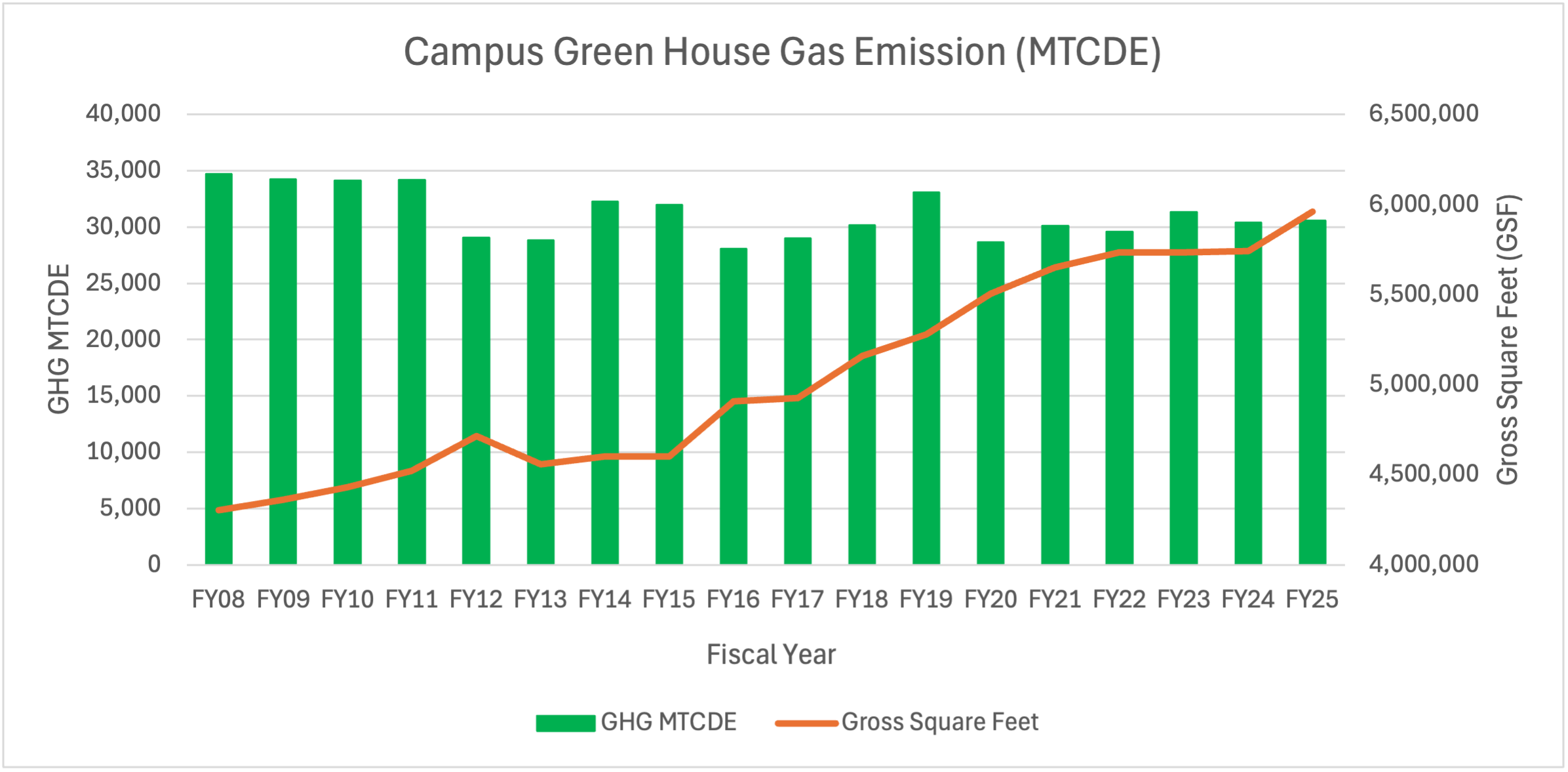
Campus emissions from the heating plant and purchased electricity has decreased by 12% since FY08. Campus gross square feet increased 43% over the same period.
This chart presents Montana State University’s Scope 1 and Scope 2 greenhouse gas emissions associated with campus energy use only, specifically emissions from the heating plant and campus utilities. Additional emissions data, methodologies, and context are available upon request.