

The Economic Value of Irrigated Agriculture in Montana
More than a quarter of crop output in Montana is irrigated -- giving irrigated agriculture
a much larger economic contribution than its share of land would suggest.
February 3, 2026
By Nick Hagerty
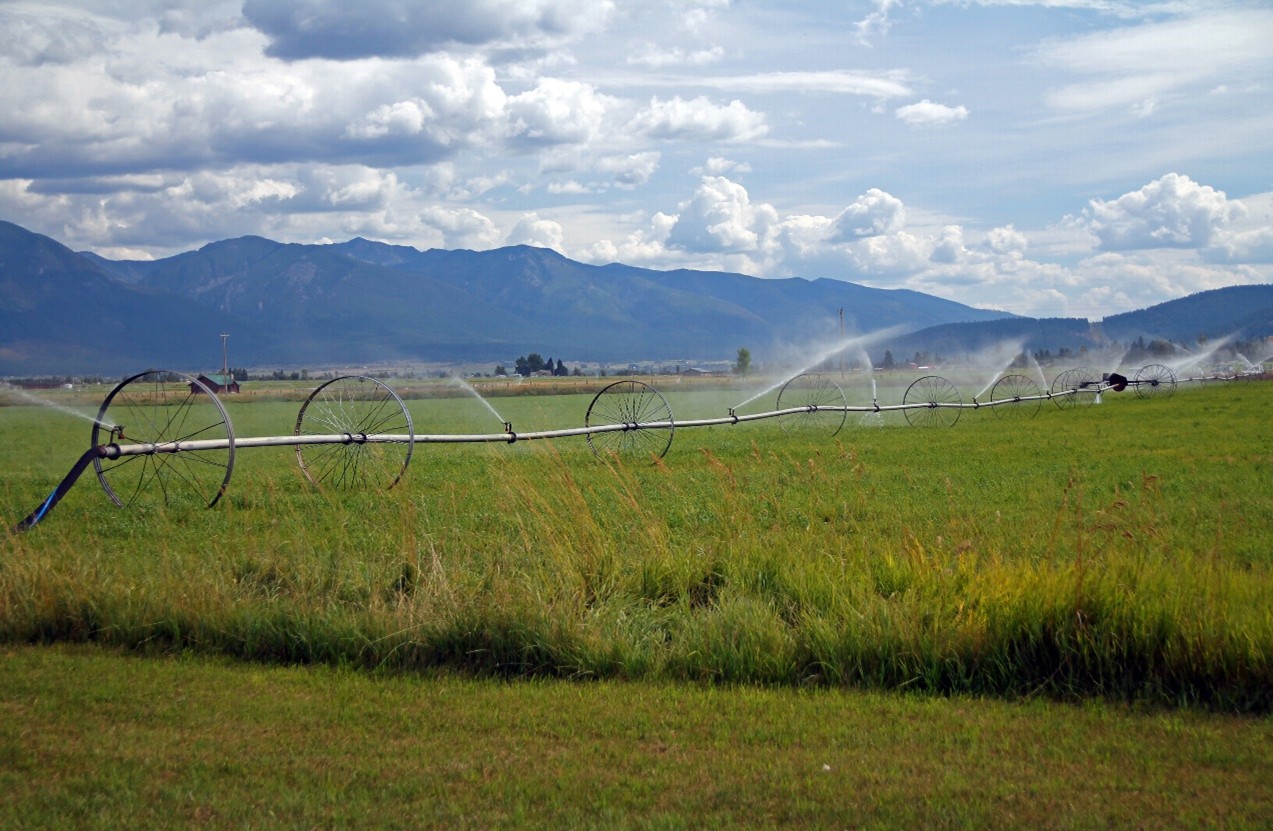
Source: https://stock.adobe.com willeye
My last post explored irrigated agriculture in Montana: how big it is and what crops are most
important. But so far I’ve looked at these questions only in terms of land area. What
about in terms of dollars – i.e., revenue, or the value of production?
Last time I showed that only 7% of cropland in Montana is irrigated. But that doesn’t
mean that only 7% of agricultural output comes from irrigation. For one thing, irrigation
can allow you to grow higher-value crops, like sugarbeets. For another, irrigation
can give you higher yields. As a hypothetical example, if only half of hay acreage
is irrigated, but irrigated hayfields get twice as many cuttings, then two-thirds
of hay production would be irrigated.
I decided to calculate the production value of irrigated agriculture, using data from
the 2022 Census of Agriculture. Here’s the bottom line: Irrigation is responsible
for 26% of the value of crop production in Montana, or $737 million (in 2022 dollars).
That’s more than a quarter -- much higher than you would expect just based on the
acreage that’s irrigated.
As usual, this number has limitations. Probably the biggest limitation is that it’s
focused only on crop production. It ignores irrigated pasture used to raise beef cattle,
Montana’s single largest agricultural product, because there isn’t currently any data
to calculate this. About one-quarter of irrigated land is pastureland, so it’s a sizeable
share of water. That said, only 1% of pastureland is irrigated, so irrigation is probably
a small share of cattle production.
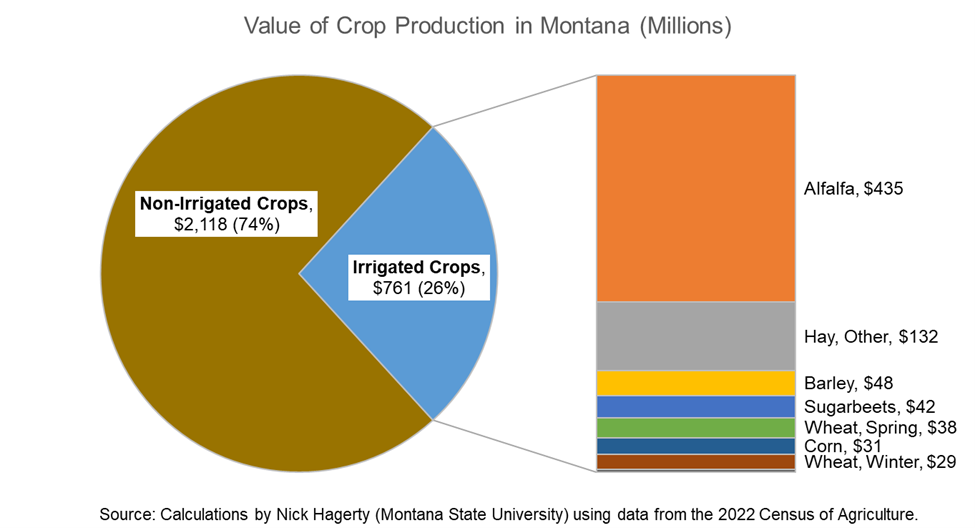
Which irrigated crops are most valuable? You can see in the graph below, which shows
the value of irrigated crops relative to all crop production in Montana and then breaks
it out by crop. Alfalfa and other hay are by far the most valuable irrigated crops,
at $567 million in total value of production.
So now let’s go back to the example above. In my last post, I showed that only 36%
of hay acreage in Montana is irrigated. But yields are very different depending on
whether the hay is irrigated. Alfalfa, for example, gets an average of 2.8 tons per
acre when it’s irrigated, and only 1.0 ton per acre when it’s not. As a result, 56%
of hay production is irrigated. Most hay acres are not irrigated, but most hay output is.
After hay, the next-most valuable irrigated crops in Montana are wheat ($67 million),
barley ($48 million), sugarbeets ($42 million), and corn ($31 million). Canola, chickpeas,
dry peas, lentils, and safflower together add up to $5.5 million. I had to exclude
a few crops for which the USDA doesn’t report the value of production (e.g., haylage,
corn silage, and oats), but they make up only 2% of harvested acres and 6% of irrigated
land, so they are unlikely to affect the totals by much.
These numbers show that irrigation’s economic importance to Montana producers far
exceeds its footprint on the landscape. Even though most cropland is not irrigated,
a large share of crop output -- and farm income -- depends on irrigation.
Note: For anyone curious about the technical details, a spreadsheet containing all my calculations and raw data can be downloaded here.

Nick Hagerty
Assistant Professor
nicholas.hagerty@montana.edu
Montana State University is an ADA/EO/AA/Veteran’s Preference Employer and Provider of Educational and Outreach.